

How to Build an A-Team That Drives Growth
What’s the number one driver of business growth?
It’s your people.
But even the best team players need a strategic vision to know where to go. “We see it time and time again that when there are issues with your team, it’s just as much about alignment as it is about compensation or culture,” says CEO Coach Mario Simon. “Your vision for the company is the foundation of your organization, and the first step toward an A-team is clarifying that and giving them room to run toward it.”
People issues are one of the biggest reasons our clients come to CEO coaching. Getting the right people in the right seats is a continual challenge for leaders—because the people that got you to your current stage aren’t always the ones that will push your organization forward.
To find and grow the right A-team, you need to be set up for success. Here’s what our coaches recommend:
1. Define what an A-team looks like organizationally
Start by the roles required, rather than the people to fill them.
“People ask the question, is Mario a good player? Is Jane a good player? And that is important,” says Simon. “But to build the organization of the future, you need to know what seats you need around the table before you can determine whether they’re the right people.”
In recent years, we’ve seen a rise in more specialized C-suite positions. That’s a good thing, says Simon. Think about these common executive seats beyond CEO and whether or not they’re what you need for your organization:
- Chief Operating Officer (COO): Efficient execution
- Chief Financial Officer (CFO): Fiscal alignment
- Chief Revenue Officer (CRO): Drive revenue growth
- Chief Experience Officer (CXO): Obsession with the customer
- Chief AI Officer (CIO): The new CTO
- Chief People Officer (CPO): Your team and office management
Right now, even if you’re doing okay as a company, even if you’re happy with your current results and your current team, there is a point coming in the future that’s going to change your current state. It could be the market, regulations, or macroeconomic events. “You’re going to need an organization that can adapt to whatever the future holds,” says Simon. “And most organizations, they’re not ready for their next phase of growth, and they’re not adaptable.”
2. Define what an A-player looks like for you
High-performing teams are built one person at a time. You need to define what success looks like before writing a job description or having a single interview.
Finding the right player can be a multiplier for your business. “The right team member can make the CEO’s vision become a reality. With top talent, you’re not performing ten or twenty percent better, but can be up to 10x stronger results,” adds Weaver. “The key to identifying them is by measurable outcomes.”
Look to past performance as the biggest indicator of success. “To hire an A-player, you have to look at their proven track record of achieving the same goals you have,” advises CEO Coach Jim Weaver. “They may look good on paper, they may interview well, but have they done before what you’re going to ask them to do?”
3. Don’t be afraid to make tough decisions about your current team
One question Weaver always asks his clients: Would you enthusiastically rehire every member of the team today?
“Inevitably, clients tell me probably not,” says Weaver. “And so then I follow up with, ‘Why are they still on the team?’ You can’t fire someone too quickly, in my experience. There are plenty of reasons why people don’t get rid of someone, but they’re really excuses.”
These kinds of tough decisions aren’t made easier when it’s someone on your team who isn’t bad at their job, or who has been at the company for a long time. To grow, you may need different skill sets or experiences for your team, and that’s okay.
“I wish Jim had helped me when I was a CEO to kick me into action,” laughs Simon. “I don’t want to fire anyone until I’ve given it my best shot to find them another place in my organization, if they’re a good performer. But really, if they don’t fit your company, they might be great somewhere else. Keeping them doesn’t help you, and it doesn’t help them.”
And if it is an underperformer, don’t hesitate. Says Weaver, “It’s easy to talk yourself into believing the person isn’t as bad as we think they are, but as the leader of the company, you’re probably the last person to see their underperformance. It has much broader implications for the culture and morale than one person.”
4. It’s not just the individual, it’s the team dynamic
An A-player won’t thrive if the team dynamic doesn’t work.
At CEO Coaching, we use TTI Assessments that can help you map out team dynamics and communication styles.
- DISC analyzes behavioral style, or the “how” behind the work. It measures how you respond to problems and challenges, how you influence and interact with others, and what kind of work environment allows you to thrive.
- Driving Forces looks at the different areas that motivate you, or the “why” behind the work. It evaluates your motivational factors, such as a love of learning, satisfaction in achieving practical results, or an impulse to help others succeed.
“From an org chart perspective, you need a mix of characteristics and personalities in the business,” says Simon. “You want some people who are very process-oriented, and others that will take risks. You want people who manage the emotional energy well, and people who know how to push hard and get the job done.”
Managing that mix is the CEO’s job. Simon recommends creating a set of operating principles that work for the whole team, no matter their individual characteristics. Being clear about who you are and how you operate, from your position as CEO all the way down to the mail clerks and janitorial staff, matters when creating a culture where a team can be a team.
5. Once you have the right people, trust them to do their jobs
The other key condition for your team to thrive? Let them do their jobs.
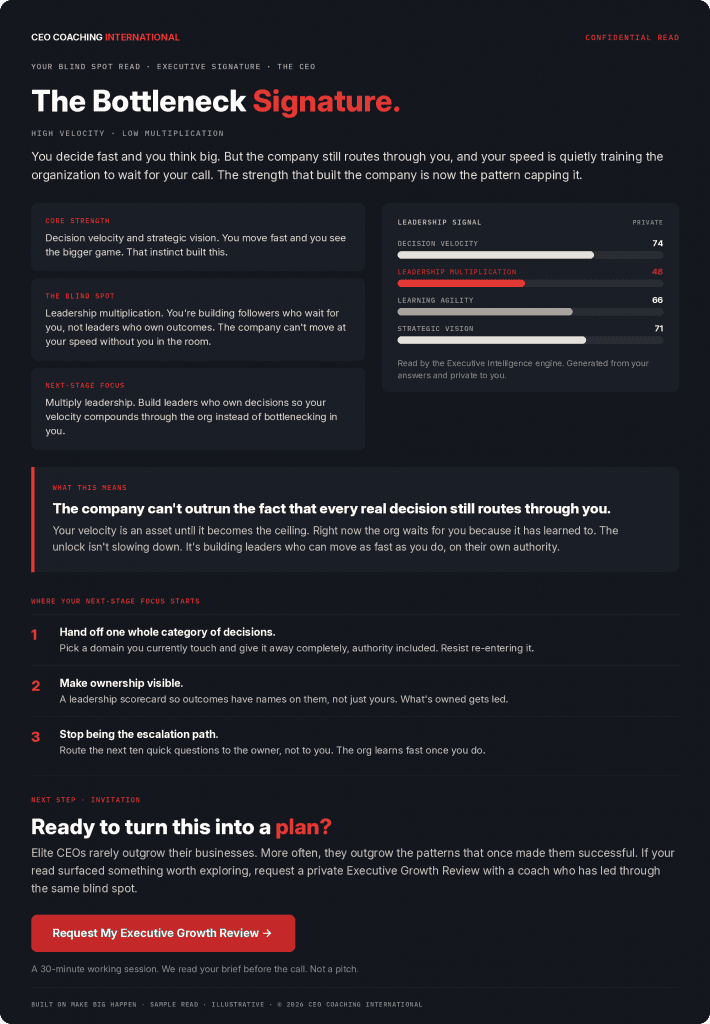
“One of the biggest mistakes I made early on in my career was becoming a bottleneck,” admits Simon. “I wasn’t an effective leader because I was so close to each person that they were coming to me rather than working together. My job as CEO is to create the conditions to have a great relationship with one another.”
That’s because you don’t run the company. Your team does. If you’ve picked the right people in the right seats, then each person should be responsible for their domain. They can bring you in if there’s a dispute or they need a decision made, sure. But the whole point of an A-team is that you don’t need to micromanage them.
Says Simon, “If it’s an HR issue, the head of HR is going to handle it. If it’s a revenue issue, the head of sales is going to handle it. I’m the last resort as CEO.”
Delegating effectively can be one of the biggest challenges for a leader, because the best leaders started as the best doers. Shifting your mindset from doer to manager at that level isn’t always easy, and that’s exactly what our coaches can help with. When it comes to people issues, sometimes you need an outsider’s eye to help you make the tough calls that set you up for growth. Book a complimentary call →
Connect With a Coach:
About CEO Coaching International
CEO Coaching International works with CEOs and their leadership teams to achieve extraordinary results quarter after quarter, year after year. Known globally for its success in coaching growth-focused entrepreneurs to meaningful exits, the firm has coached more than 2,000 CEOs and entrepreneurs across 100+ industries and 90 countries. Its coaches—former CEOs, presidents, and executives—have led businesses ranging from startups to over $10 billion, driving double-digit sales and profit growth, many culminating in eight, nine, or ten-figure exits.
Companies that have worked with CEO Coaching International for two years or more have achieved an average revenue CAGR of 22.8%, nearly 2X the U.S. average, and an average EBITDA CAGR of 37.5%, nearly 3X the national benchmark.
Discover how coaching can transform your leadership journey at ceocoachinginternational.com.
Learn more about executive coaching | Meet our world-class coaches