

The 5 Patterns That Limit Business Growth
What does success look like three years from now?
You may have a clear answer. But if you asked your leadership team, would their answers be consistent with yours?
If the answer is no, you’re not alone.
Lack of team alignment is one of the biggest issues holding businesses back from fulfilling their growth potential. “Most of the time, the CEO is clear, but the organization isn’t aligned,” says CEO Coach Gordon Forsythe. “And when you’re not aligned, people work toward different priorities, spreading resources too thin, slowing down execution, and keeping you from meeting your goals. You don’t always feel it immediately, but it makes everything a struggle.”
This is just one common pattern Forsythe and fellow CEO Coach Randy Wootton see with their clients when they first come to CEO Coaching International. In this post, we’ll talk through the most common CEO mistakes they see that holds businesses back, and how to fix them:
1. Using a budget as strategy instead of creating a repeatable accountability rhythm
Clarity isn’t about having a vision. It’s about a plan that your organization can execute. But when it comes to annual planning sessions, most CEOs mix up having a plan with a budget, and those are not the same thing.
“A real annual plan answers three questions: What are your top priorities? What are you not doing? And what are you going to execute on? This is where strategy becomes action,” says Forsythe. “Without that clarity, businesses don’t align.”
You need to sequence building that plan with the financial piece so that you can better allocate resources, and convince the board. “One of the things I often talk to clients about with that strategy conversation is separating those two conversations,” says Wootton. “If you want people aligned, you have to build out the plan and the budget, and then launch. So a January launch means you’ve already locked it down by December, which means you started in September. Most companies wait and realize they’re already in February without a plan for the year.”
Success in annual planning looks like:
- Clear priorities, broken down into specific actions
- A consistent rhythm of accountability
- Transparent, measurable KPIs that track progress throughout the year
“Your team doesn’t need more goals,” says Forsythe. “They need a clear path forward together.”
2. Measuring the wrong KPIs instead of measuring what matters for your goals
Forsythe recalls facilitating a client session where the team was excited about their KPIs. “I’m looking at the CEO, and all I could think was, ‘I’m going to get fired,’” he says. “What they were measuring was not going to achieve their goals. They were so happy everything was green on the dashboard that they didn’t stop to think about whether it was the right numbers.”
KPIs aren’t just numbers on a dashboard, but they serve as an early indicator of whether your plan is actually working. Of course, we all want to see green, but when problems show up too late, you end up putting out fires instead of being intentional with your time.
High performing companies do three things:
- Identify the few metrics that truly drive the business to where they want to go
- They connect those metrics to specific action
- And they review those metrics with discipline and frequency
Once you have the right KPIs in place, the next question becomes: What can you do each day to move them?
3. Mixing up important vs. urgent tasks instead of focusing on what moves the needle
Not all work is created equal.
Forsythe recalls another client who couldn’t figure out why their company wasn’t growing. “He didn’t have anything on his calendar related to his goals,” he explains. “He was just jumping from thing to thing. CEOs need to focus on the highest payoff activities that have the biggest impact on the company.”
“It’s so easy to get sucked up into the urgent,” agrees Wootton. “Everybody wants you to do something that day, but a CEO needs time to think about the strategy, their key relationships, their competitive positions. It’s easy to sit in a meeting or to send more emails, but that isn’t work, that’s just activity.”
High-performing CEOs:
- Structure their time intentionally
- Focus on a few activities that move the KPIs
- Protect their time relentlessly
- Delegate everything else with clarity and accountability (more on that below)
Your calendar is a great place to see if you’re putting your money where your mouth is. If it’s not on the calendar, it’s probably not happening.
4. Trying to do too much instead of trusting your team
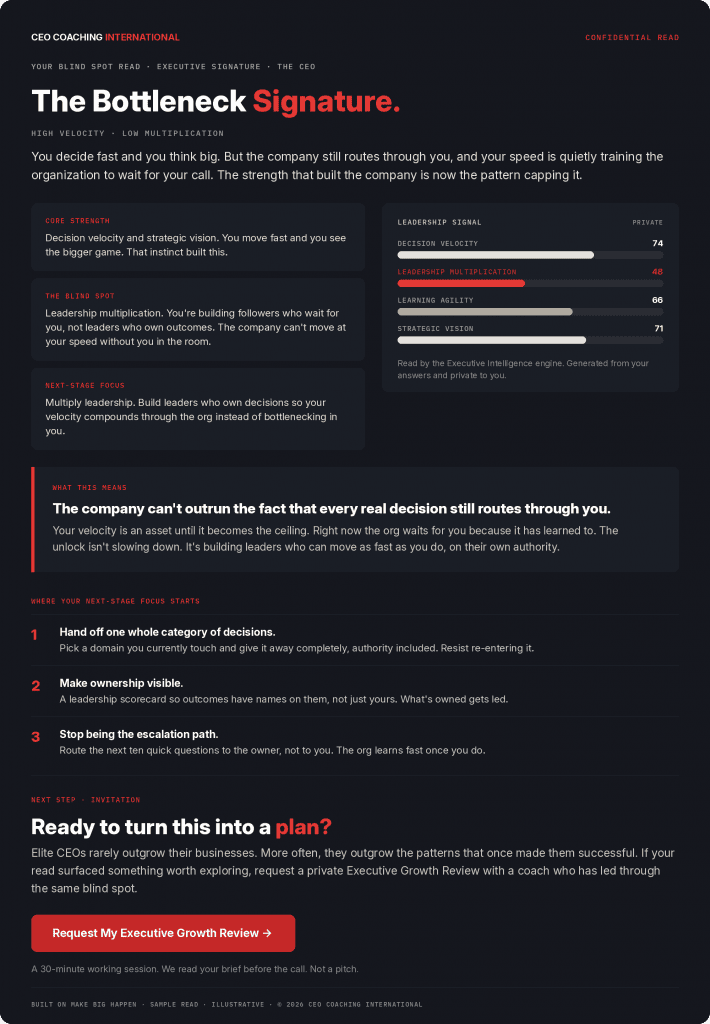
One of the biggest constraints on growth? When the CEO tries to do it all.
You’re only one person. The business can’t scale if it has to go through you.
“CEOs think they need to be involved in every single decision, but the truth is, if you build the capabilities of the people below you to do things really well, you don’t have to,” says Wootton. “You’ve got to understand who the individual is and what are their capabilities, what are their experiences, and what sort of support they need to get it done.”
You’ve hired them for a reason, and you need to give them the authority to make decisions and move the company forward. “You’re in charge of the ship, and it’s an enormous responsibility, but you still must let things go,” he adds. “Create a system of checks where you can still have oversight without having responsibility. Your people will know if you don’t trust them. Delegate and elevate.”
As CEO, your job isn’t to do more, but to focus on the key priorities: Vision, Cash, People, Key Relationships, and Learning. Outside of that, you need to effectively delegate to your team.
5. Letting blind spots win instead of creating active feedback loops
“Every CEO has blind spots,” says Forsythe. “You can’t see it, because that’s what it is. The issue isn’t that it doesn’t exist but that no one is telling you what it is, and that’s a challenge.”
A blind spot may not show up right away. But as you scale, fewer people challenge you. Feedback gets filtered, and small issues end up becoming big problems. “What you don’t see eventually limits the business, because your team adapts around you instead of being honest with you,” he adds.
It’s easy to get defensive or bristle when you receive feedback—it’s a natural response. Try to move past it and see what feedback really can be: A competitive advantage. Says Forsythe, “the difference we see across companies isn’t intelligence or effort, but how consistently they operate in their execution, and how willing a CEO is to find and fix their performance gaps as a person and as a company.”
You may already know what’s holding your business back. Or it could be a blind spot. If you’re curious about how a coach can help you break through these blocks and make BIG happen, book a complimentary call today →
Connect With a Coach:
About CEO Coaching International
CEO Coaching International works with CEOs and their leadership teams to achieve extraordinary results quarter after quarter, year after year. Known globally for its success in coaching growth-focused entrepreneurs to meaningful exits, the firm has coached more than 3,500 CEOs and senior leaders across 160+ industries and 94 countries. Its coaches—former CEOs, presidents, and executives—have led businesses ranging from startups to over $10 billion, driving double-digit sales and profit growth, many culminating in eight, nine, or ten-figure exits.
Companies that have worked with CEO Coaching International for two years or more have achieved an average revenue CAGR of 22.8%, nearly 2X the U.S. average, and an average EBITDA CAGR of 37.5%, nearly 3X the national benchmark.
Discover how coaching can transform your leadership journey at ceocoachinginternational.com.
Learn more about executive coaching | Meet our world-class coaches