

5 Essential Skills for the Modern CEO in 2025
At the beginning of 2025, we advised both our CEO coaching clients and our audience to prepare for an unpredictable year with a wide range of potential outcomes. Safe to say, that prediction has borne out. The rate of change in the world, the economy, and your business space shows no signs of slowing down.
Are you, as a leader, keeping pace?
In this volatile environment, your skillset has to evolve beyond traditional management. Build out your abilities in these five areas so that you’re ready to Make BIG Happen no matter what else 2025 has in store.
1. AI and Data Fluency
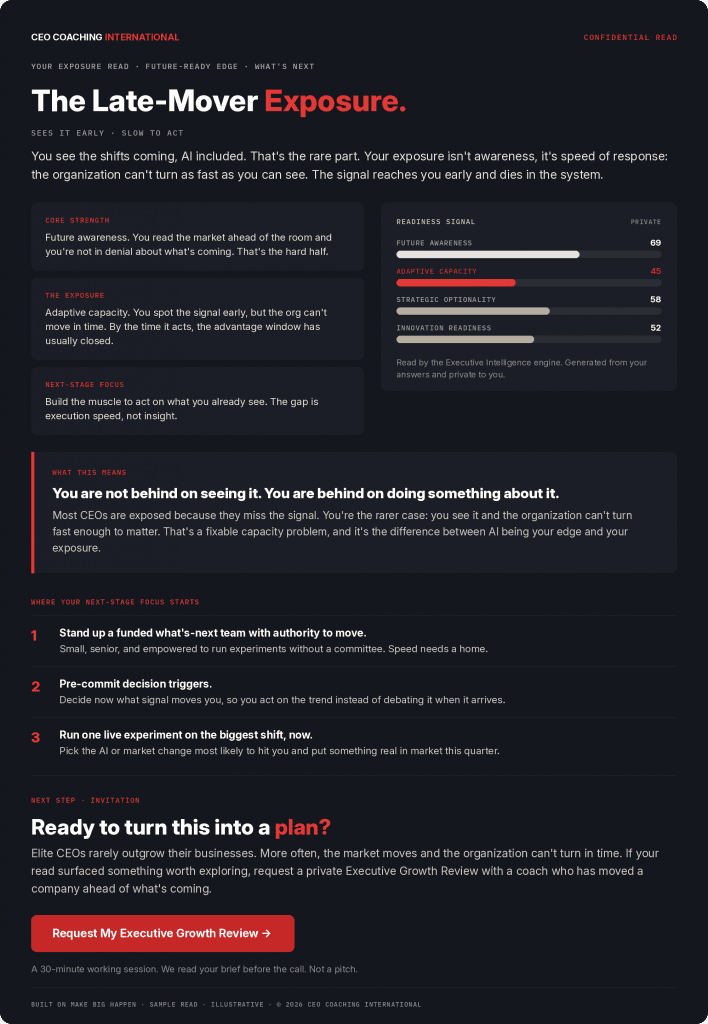
Why it Matters: If you didn’t implement an AI Roadmap as part of your annual planning, you’re not just behind the curve — you’re losing the race. AI isn’t some futuristic “maybe.” It’s transforming every business, right now, from automating routine tasks to anticipating market moves and customer demands. You can’t afford to wait on AI integration any longer.
The CEO’s Role: It’s not your job to be a coder or even the company’s AI expert. But you do need to understand what kinds of integrations are available, how to collect and interpret high amounts of data, and how AI can improve the experience your company delivers to employees and customers. Start by hiring the best Chief AI Officer you can find and then work through the following.
Actionable Steps
- Leverage AI-powered insights for better decision-making. Implement AI tools to analyze market trends, customer behavior, and operational efficiency. Follow the data and plan for best-case and worse-case scenarios. Optimize or automate any process that keeps your best people from doing creative work or delivering face-to-face service.
- Stay informed about AI advancements relevant to your industry. Attend conferences, read publications, engage with AI experts, and keep an eye on how your competitors are integrating AI.
- Invest in AI literacy across the leadership team. Invite AI experts to speak to your company about potential implementations and provide training during work hours. Empower leaders and their teams to experiment with free AI tools like ChatGPT to speed up simple tasks like drafting emails. Encourage curiosity and reward innovative solutions.
2. Strategic Agility
Why it Matters: AI and U.S. politics might be the headline news, but the BIG business picture is even BIGGER and more complicated. CEOs can’t afford to wait around for a clear path forward to reveal itself — they have to blaze the trail and keep an eye out for alternate routes.
The CEO’s Role: Remember the lessons from your pandemic pivot. Master the facts on the ground, but take nothing for granted. Anticipate changes and game out potential outcomes. Position your company to provide stability for rattled customers and employees. Fill any niches your flat-footed competitors are overlooking or conceding.
Actionable Steps
- Encourage experimentation and rapid iteration within the company. Maintain a culture that prides itself on innovation. Take shots, follow hits, and learn from misses.
- Develop scenario-planning skills to prepare for multiple futures. Tweak your AI-powered projections to include best-case and worst-case scenarios and have contingency plans at the ready.
- Balance short-term execution with long-term adaptability. Today’s essential tasks can’t just keep the lights on. Your company has to maintain steady progress towards your BIG quarterly and annual targets.
3. Talent Magnetism
Why it Matters: The absolute best talent votes with their feet. And they know that in this constantly shifting economy, their options will continue to multiply. If you’re competing for second-tier workers, you’re never going to build a top-tier company.
The CEO’s Role: Create a people-first environment where talent thrives, professionally, personally, and financially, and protect that environment above all else. Reward high achievers. Replace anyone who isn’t buying in.
Actionable Steps
- Foster a culture of autonomy, purpose, and impact. Give your best people room to do what they do best, how they see fit–within cultural norms. Celebrate wins so that every employee appreciates how their daily contributions are moving the whole company forward.
- Reimagine compensation and incentives beyond salary. Money talks, but so do purpose and values. Benefits like weekly volunteer hours and sabbatical time can help workers connect their jobs, and their employer, to community and causes. Show your best workers clear paths to promotion and ownership.
- Build a workplace that supports hybrid and remote teams effectively. Having your teams in the office to collaborate and build camaraderie is important. But so is providing employees with the flexibility they need to feel like they have control over their careers and meaningful work-life balance.
4. Mastering Storytelling
Why it Matters: A CEO’s ability to craft and communicate a compelling vision determines how well employees, customers, board members, and investors engage with the company. A collection of buzzwords won’t cut it. Neither will paying lip service to trending #hashtags. And if your story is just about profits, your most important stakeholders are going to tune you out.
The CEO’s Role: Look into your Crystal Ball and communicate what you see with consistency and clarity.
Actionable Steps
- Develop a narrative that ties company vision, mission, and values together. Your story has to be BIG enough to communicate everything you stand for and inspiring enough to make all shareholders feel like they want to be a part of it.
- Use storytelling to simplify complex ideas for different audiences. Your board of directors shouldn’t receive the same memos as your shareholders. Read the room and modulate your messaging appropriately.
- Be authentic. At great companies, business is always personal. Connecting your life experiences and leadership to your company will help stakeholders do the same.
5. Cognitive Flexibility
Why it Matters: It’s not easy to “flip the switch” between visionary and manager. But CEOs need to be able to identify the highest uses of their time, meeting by meeting, moment by moment, and maintain a consistent level of mastery, decisiveness, and leadership.
The CEO’s Role: The best CEOs always have a clear grasp on how tactical execution is connected to big-picture strategy and can zoom in or out seamlessly. They can think like a futurist in one meeting, a financial analyst in another, and a frontline employee in the next. This mental agility is key to seeing their businesses from multiple angles and leading through complex situations.
Actionable Steps
- Cultivate curiosity. Draw inspiration and insights from businesses and leaders outside your field.
- Train yourself to shift between macro and micro views seamlessly. Master the details that are building to BIG.
- Surround yourself with diverse thinkers. Fill your most important seats with high performers who will challenge and enhance your company’s culture and your strategic thinking.
We often advise our CEO coaching clients that what got you this far might not get you to the next level. Whether you’re a seasoned vet or a first-time leader, 2025 is going to be even harder for CEOs who think they have it all figured out. Complacency, arrogance, and a lack of self-awareness are more significant threats to your business than anything that will happen in Washington or Silicon Valley. If you can’t see the upgrades you need to make as a leader, then work with a CEO coach who can help you future-proof your company and keep Making BIG Happen.
About CEO Coaching International
CEO Coaching International works with CEOs and their leadership teams to achieve extraordinary results quarter after quarter, year after year. Known globally for its success in coaching growth-focused entrepreneurs to meaningful exits, the firm has coached more than 3,500 CEOs and senior leaders across 160+ industries and 94 countries. Its coaches—former CEOs, presidents, and executives—have led businesses ranging from startups to over $10 billion, driving double-digit sales and profit growth, many culminating in eight, nine, or ten-figure exits.
Companies that have worked with CEO Coaching International for two years or more have achieved an average revenue CAGR of 22.8%, nearly 2X the U.S. average, and an average EBITDA CAGR of 37.5%, nearly 3X the national benchmark.
Discover how coaching can transform your leadership journey at ceocoachinginternational.com.
Learn more about executive coaching | Meet our world-class coaches