

Part I: Building Intelligence, Agility, and Resilience
2026 will test how adaptable and imaginative you and your leadership team really are.
Between AI disruption, economic uncertainty, and geopolitical tension, the winners won’t be those who predict the future perfectly, but those who prepare for multiple versions of it.
Sometimes CEOs use the phrases “annual plan” and “roadmap” interchangeably. But your plan for 2026 has to be more dynamic than a single path from A to BIG. You need a true playbook that defines what winning looks like while also establishing what kinds of audibles you might need to call and how to maintain the resilience you’ll need to adapt.
To create your dynamic playbook, these four items should be at the top of your 2026 annual planning agenda.
1. AI Integration and Human Redesign
Why it matters: AI is no longer a “nice-to-have.” And its impact is no longer a hypothetical. AI is fundamentally reshaping cost structures, productivity, customer acquisition, and resource allocation, including what teams look like and what they do. Companies that treat AI like an IT research project will be lapped by competitors who embed AI into the core of their operations.
Take Amazon as an example. On June 17, 2025, CEO Andy Jassy sent a memo to employees and made some startling comments.
“Today, in virtually every corner of the company, we’re using Generative AI to make customers’ lives better and easier. What started as deep conviction that every customer experience would be reinvented using AI, and that altogether new experiences we’ve only dreamed of would become possible, is rapidly becoming reality. Technologies like Generative AI are rare; they come about once-in-a-lifetime, and completely change what’s possible for customers and businesses.”
And that change also impacts employees.
Jassy said as they roll out more Generative AI and agents, “We will need fewer people doing some of the jobs that are being done today, and more people doing other types of jobs. It’s hard to know exactly where this nets out over time, but in the next few years, we expect that this will reduce our total corporate workforce as we get efficiency gains from using AI extensively across the company.”
It’s transformation at warp speed. And all leaders need to get on board. The best offense is to “be curious about AI, educate yourself, attend workshops and take trainings, use and experiment with AI whenever you can,” said Jassy.
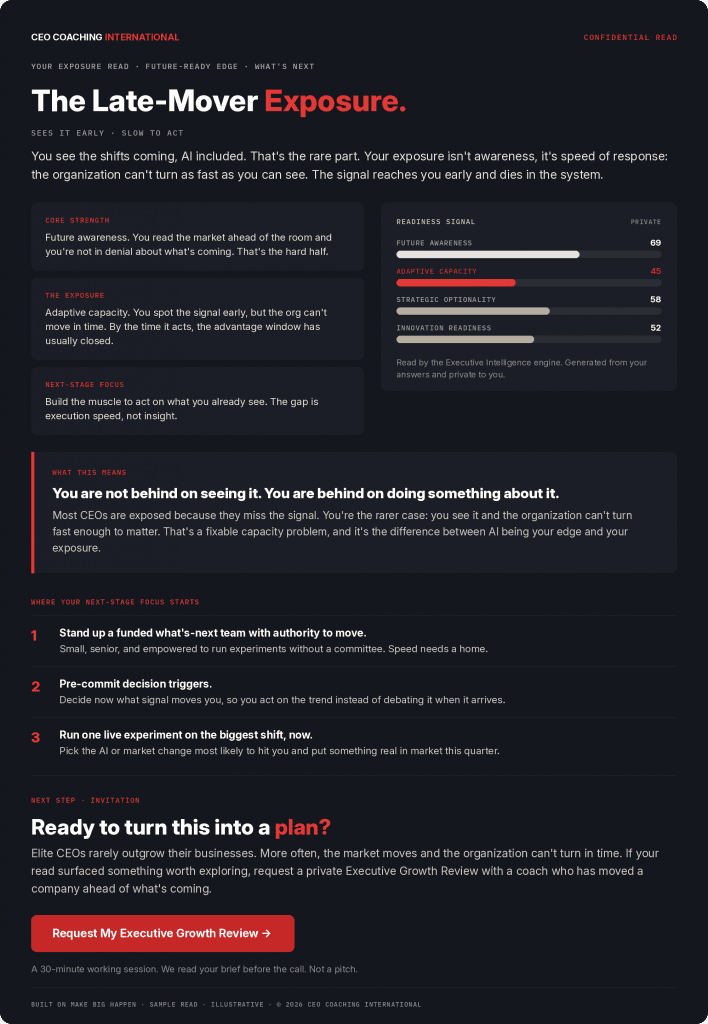
And with that in mind, we recommend you bring AI to your upcoming planning session.
New for 2026: Bring a “Fifth Voice” to Your Annual Planning Session.
Don’t just talk about AI, use it to plan. Create a custom Generative Pre-trained Transformer (GPT) trained exclusively on your company’s data: playbooks, financials, KPIs, client personas, sales and customer service scripts, CRM data, job descriptions and employee talent insights, and transcribed notes from every recorded meeting
At your 2026 annual planning session, your custom GPT will be able to:
- Surface historical data instantly. “Why did we cut the marketing budget in Q3 2024? And by how much?”
- Simulate how strategic decisions might play out. “Model the impact on long-term cash flow if the top 10% of our customers continue to drive the majority of our sales.”
- Challenge assumptions by drawing from external intelligence. “Cross-reference our 2026 growth projections against market data, competitor moves, and economic forecasts.”
Key Questions to Discuss:
- How can AI enhance — not just replace — human intelligence and creativity inside our company?
- What parts of our workflow are ripe for automation (doing the same things faster) versus augmentation (enabling our people to do new things, or freeing them to provide better person-to-person service)?
- What is our AI governance and data ethics framework? Do current policies or integrations put our IP or customer data (read: privacy) at risk?
Action Steps:
- Identify 2–3 business functions where AI could create measurable ROI in 2026. Start with low-hanging fruit like automation and data collection.
- Invest in employee upskilling and prompt literacy. Teach your team how ask AI the right questions and encourage experimentation.
- Assign accountability for AI adoption. If AI is everyone’s job, then it’s no one’s responsibility. Hire a Chief AI Officer who can drive impactful integration and education.
Oh, and don’t forget to lock down your data! Make sure your custom GPT is walled-off from outside access. Look into ChatGPT Enterprise, Azure OpenAI, or use your own private database that stores your company’s documents privately. You can then connect the GPT to that database via an API so your company data never leaves your control.
2. Scenario Planning in an Era of Volatility
Why it matters: In March of 2020, the pandemic forced CEOs to completely rewrite their annual plans. In 2026, you might need to make major pivots quarterly, or even monthly. We’re living in a world of ongoing system shocks: political, financial, cultural, and technological. Your annual vision should be clear, but it should also include offramps, onramps, and contingencies that cover multiple scenarios.
Key Questions to Discuss:
- What are the 3–4 plausible futures we might face by 2027? Here’s an obvious one: the two-speed economy will continue bifurcating your customer base for at least another 6 months.
- What are the specific, measurable, early-warning indicators that would tell us a new scenario is unfolding?
- How can we create contingency playbooks for each of these scenarios ahead of time so we aren’t improvising during a crisis? They don’t have to be highly detailed but should give you a running start if you have to implement them.
Action Steps:
- Conduct a half-day scenario workshop with your leadership team before your 2026 annual planning session. This essential pre-work will align every level of your organization around common challenges, concerns, and, hopefully, some opportunities as well.
- Assign “scouts” on your team to monitor the key signals identified in your workshop. If interest rates change or the balance of political power shifts in a key market, someone should have a report on your desk by Monday morning.
- Integrate scenario thinking into quarterly reviews. Start your quarterly meetings by establishing baselines. Ask, “Which scenario are we in?” and assess how your plan for the next quarter may need to adapt.
3. Recession and Inflation Readiness
Why it matters: This year, the positive, can-do tone that CEOs have to strike at an annual planning session should come not from a place of optimism, but from a place of readiness. You can’t “hope” away the likelihood of rolling recessions in key markets, inflation flare-ups, customers tightening their belts, and higher capital costs. But you can start planning now for potential disruptions so that you can shore up weaknesses and prep for quicker, cleaner pivots. Showing your people that you’re ready to tackle the very things they’re worried about will keep your troops rallied and ready.
Key Questions to Discuss:
- How exposed is our business to rising interest rates or slowing customer demand?
- What is our detailed playbook if revenue drops 15% or our costs spike 10%? How much pain are we willing to absorb? What kinds of cuts might we have to make? How can we grow through a downturn?
- How much “dry powder” (cash) should we keep on hand and how much should we be allocating for potential growth opportunities that competitors are too timid to grab?
Action Steps:
- Stress-test your P&L and cash flow under multiple scenarios. Ask your CFO, and your new GPT, to establish guardrails and “break-the-glass” metrics.
- Add a recession plan to your playbook right now. The best time to plan for worst-case scenarios is before they happen. In the middle of a major downturn, you and your team will be too busy putting out fires to make a calm, rational assessment of how to stay in the black. Focus on pricing strategy, expense prioritization, and customer retention.
- Lock in favorable financing before capital markets tighten. Similarly, the best time to top off your war chest is when it’s already full. Get meetings with your banker and major lenders or investors on the books before the end of the year.
4. Geopolitical Risk and Supply Chain Security
Why it matters: Worrying about elections, legislation, and executive orders isn’t just for the Apples and Amazons of the world anymore. Supply chains, materials costs, labor access, and even customer sentiment are all geopolitical issues now. A conflict halfway around the world could grind your factory to a halt. And projecting a divisive message on social media to a customer base that’s already fragmented around a myriad of issues could break, arguably, the most important link in your chain.
Key Questions to Discuss:
- Where are we most exposed geographically? Who, and where, are our key suppliers and customers?
- What is our backup plan if a key region faces disruption from conflict, trade policy, or a natural disaster?
- How might rising nationalism, tariffs, or sanctions affect our costs and our ability to sell in key markets in 2026? Where will we pivot if we need to buy more efficiently or sell to more customers?
Action Steps:
- Map your supply chain for critical dependencies. Who supplies your main suppliers? Who are their competitors? Where are potential choke points? And how can you broaden your own chain?
- Explore “friend-shoring” or regional diversification. Establishing additional supply chain links in areas that are more stable or closer geographically can be an investment in resilience, even if they cost more.
- Assign risk owners and develop rapid response protocols. Who makes the call to switch suppliers or cancel a shipment? If it’s currently the CEO, you might be placing an unnecessary bottleneck on a critical decision.
Part II: Designing for Growth and Trust
The first half of your annual planning should focus on intelligence and resilience — understanding what’s changing in the world and how your business can adapt.
In Part 2, we will discuss why the second half of your session must focus on design. How you plan to allocate resources, lead your team, and build trust with customers in a transformed marketplace will be vital to Making BIG Happen in 2026.
If you don’t have a coach and want one to help you prepare your business during this quickly evolving landscape, fill out the form below to take us up on a complimentary 1:1 coaching call.
Connect With a Coach:
About CEO Coaching International
CEO Coaching International works with CEOs and their leadership teams to achieve extraordinary results quarter after quarter, year after year. Known globally for its success in coaching growth-focused entrepreneurs to meaningful exits, the firm has coached more than 3,500 CEOs and senior leaders across 160+ industries and 94 countries. Its coaches—former CEOs, presidents, and executives—have led businesses ranging from startups to over $10 billion, driving double-digit sales and profit growth, many culminating in eight, nine, or ten-figure exits.
Companies that have worked with CEO Coaching International for two years or more have achieved an average revenue CAGR of 22.8%, nearly 2X the U.S. average, and an average EBITDA CAGR of 37.5%, nearly 3X the national benchmark.
Discover how coaching can transform your leadership journey at ceocoachinginternational.com.
Learn more about executive coaching | Meet our world-class coaches