
Show Notes
Overview: What happens when the person holding your business back is someone you genuinely like, respect, and want to succeed?
It’s one of the hardest decisions a CEO can face. And for Dan Berkon, it became one of the most important leadership lessons of his career.
Dan is the founder and CEO of Culmen International, a company with more than 450 employees operating across six continents, supporting critical national security missions. The company has been recognized on the Inc. 5000 list 11 times and has completed seven acquisitions.
But Dan’s entrepreneurial journey began long before Culmen.
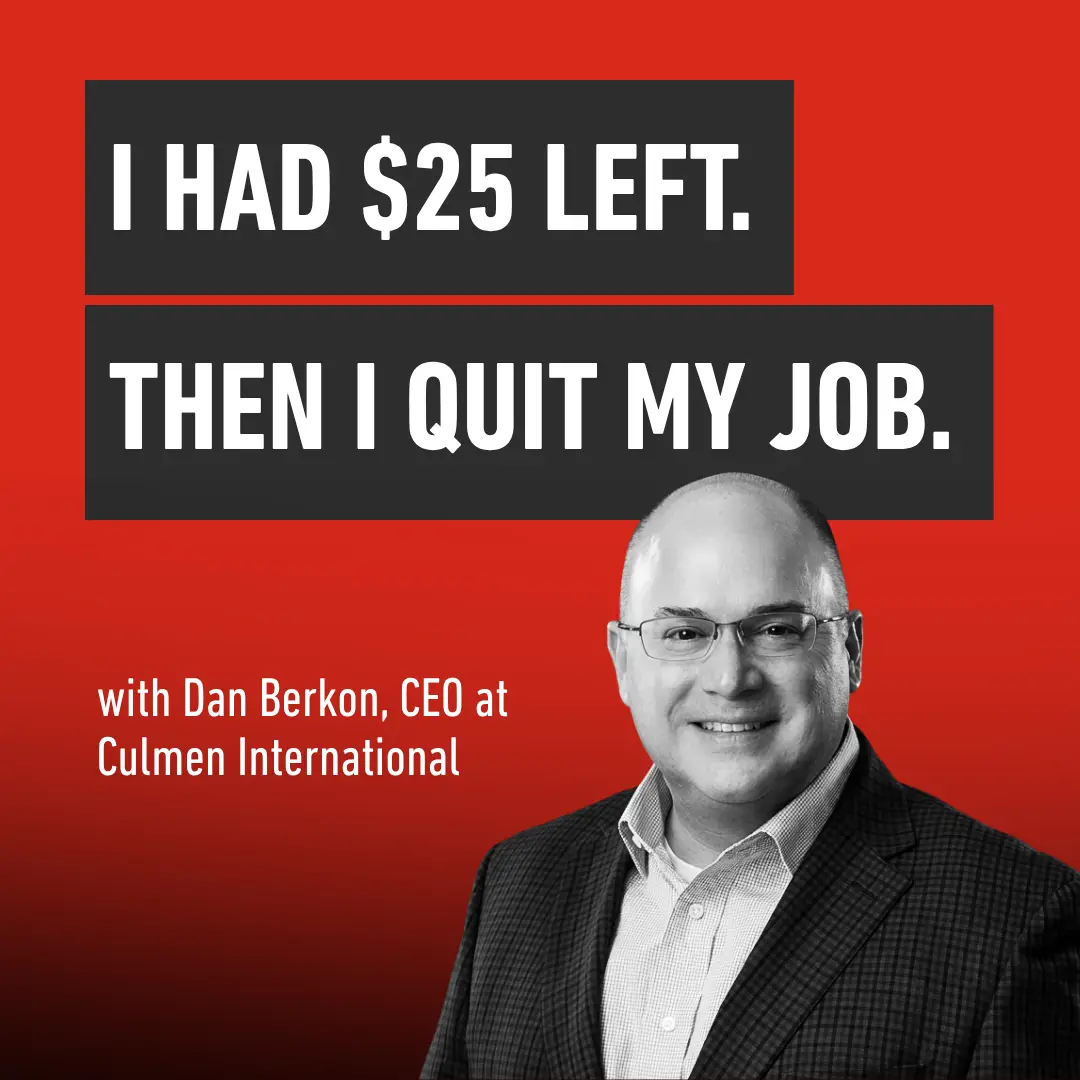
At 17, his family lost its business and home. At 18, he joined Mark Moses‘s Student Painters company to learn how to become an entrepreneur. Years later, he left a successful career to start his own business with just $25 in the bank.
Today, Mark serves on Culmen’s board and has coached Dan for more than a decade.
On the Make BIG Happen® Podcast, Dan and Mark discuss the leadership decisions that transformed Culmen, why culture matters in acquisitions, how the right board can accelerate growth, and what it takes to build a company that no longer depends on its founder.
1. From Losing Everything at 17 to Starting a Business With $25
Dan grew up watching his father run a small business.
He saw the independence entrepreneurship could provide and imagined building something of his own.
Then everything changed.
A few months before Dan started college, his father lost the family business. The family also lost its home. At 17, Dan was on his own, trying to figure out how to pay for college and secure his financial future.
He knew he wanted to separate his earning potential from the number of hours he could work.
So, at 18, he joined Student Painters. He wasn’t simply looking for a summer job. He wanted to learn how to run a business. The experience taught him something that would shape his leadership philosophy for decades.
Success wasn’t just about what he could accomplish personally. It was about what he could help other people accomplish.
As a branch manager, Dan recruited people he knew to lead painting crews. He discovered how rewarding it was to mentor others and watch them achieve more than they thought possible.
At 19, he became a district manager, learning to adapt his leadership style to different personalities and motivations.
Years later, Dan pursued his interest in international security and eventually became chief operating officer and executive vice president at a government contracting company.
After 11 years, he wanted to do things differently. Rather than challenge the founder’s right to lead the business his way, Dan decided to build his own.
He resigned, gave back his ownership interest, and started Culmen International. He and his wife, Tammy, had three children at the time. Dan was the family’s sole income provider. They had just $25 in the bank.
But Tammy believed in what he wanted to build, and Dan was determined to make it happen.
Key Takeaway: Building something extraordinary often begins with a difficult decision. Dan didn’t have financial security or a guaranteed outcome. He had a vision, a willingness to learn, and the support to pursue it.
2. The CEO Who Built the Business Can’t Keep Doing Everything
When Dan began working with Mark as his coach, Culmen was generating approximately $20 million in annual revenue.
Mark asked him what he wanted to achieve.
Dan thought reaching $100 million would be amazing. Today, Culmen has grown well beyond that ambition.
But getting there required Dan to confront a fundamental limitation. The company depended too heavily on him.
Culmen had reached the point where it needed to evolve from an entrepreneurially led business into a professionally managed organization.
That meant building an executive team, implementing stronger systems, and moving away from Dan personally leading everything.
He needed to become a leader of leaders.
And he discovered that hiring one or two exceptional executives wasn’t enough.
Great people were needed throughout the organization.
That philosophy shaped everything from recruiting to employee development.
Dan’s mother, who had extensive experience in defense-sector recruiting, helped establish Culmen’s early talent acquisition function.
He wanted potential employees to experience the company’s culture from their very first interaction.
And once they joined, he wanted them to feel supported.
Dan recalled an HR professional who described the job as protecting the company from its employees.
He disagreed. The job, he explained, was to help the company take the best possible care of its people so they would want to stay and do great work.
Over time, Culmen built the leadership depth and organizational capabilities needed to support continued growth.
Key Takeaway: A business eventually reaches a ceiling when everything depends on its founder. Breaking through requires building leaders, systems, and a culture capable of producing results without the CEO directing every decision.
3. Nice Guy Is Not a Profession
One of Dan’s most difficult leadership decisions involved an executive he genuinely wanted to succeed.
The person was experienced, capable, committed, and hardworking, but the results weren’t there.
Dan struggled because this wasn’t someone with a bad attitude or a lack of effort. It simply wasn’t the right fit.
He kept asking himself what more he could do to help.
Was he providing enough support?
Was he doing everything possible as a leader?
During a coaching conversation, Mark challenged him with a principle that became one of his most memorable leadership lessons.
Nice guy is not a profession.
Dan knew something needed to change, but he waited.
Looking back, he estimated that he delayed the decision by six months to a year, and the consequences extended beyond that individual.
Other employees could see the problem. The executive knew things weren’t working, too. The uncertainty affected morale.
As Dan explained, nobody benefited from dragging out the decision.
Eventually, he moved the executive into a different role where the person became far more successful.
Culmen then filled the original position with someone better suited to its demands.
The change improved results and relieved the uncertainty surrounding the situation.
Dan realized that delaying the decision hadn’t protected anyone. It had simply prolonged a problem everyone already recognized.
Key Takeaway: Being a good person and being the right person for a particular role aren’t the same thing. Avoiding a difficult people decision doesn’t make it easier. It often makes the consequences worse.
4. Seven Acquisitions. One Lesson About Culture.
Culmen has completed seven acquisitions.
Its first came in 2011, when Dan acquired the company where he’d previously spent 11 years of his career.
Six more acquisitions followed beginning in 2018.
Mark pointed out that none of Culmen’s acquisitions had resulted in a failed integration.
Dan was quick to acknowledge that the company had made plenty of mistakes along the way.
But those experiences taught him an important lesson: successful integration begins before the deal closes.
Early on, Culmen didn’t think deeply about integration until after completing an acquisition. Now, integration considerations help determine which businesses the company wants to acquire.
And one factor matters enormously.
Shared values.
When companies have similar principles, cultures, and visions, bringing them together becomes much easier.
Dan highlighted Culmen’s 2023 acquisition of Vysnova Partners.
The businesses were closely aligned culturally, and Vysnova’s former owners joined Culmen’s executive leadership team. They helped employees understand the opportunity and feel confident about becoming part of the larger organization.
Dan applies the same philosophy internationally.
When Culmen acquired a company with operations in Georgia, he personally visited the team to share the company’s vision and values. Other executives visited as well.
He understood that building culture across borders requires more than announcements and organizational charts.
It requires relationships.
Key Takeaway: Acquisitions aren’t just about financial performance or strategic fit. Shared values and thoughtful integration can make the difference between two companies simply coming together and becoming a stronger organization.
5. Your Board Should Be a Superpower, Not a Straitjacket
In December 2019, Culmen brought in minority private equity partner Hale Capital Partners.
The company was growing rapidly. It had completed acquisitions and secured significant contracts that required more capital than its existing financing arrangements could provide.
But Dan wasn’t ready to give up control of the business he’d built.
He wanted a partner who could provide capital, expertise, and support while respecting Culmen’s vision, so he met with multiple minority private equity firms.
He was transparent about the company’s strengths, its challenges, and what he wanted from a partnership.
Ultimately, he chose Hale Capital because he believed they shared Culmen’s values.
The investment brought more than money. It brought experienced board members, stronger performance measurement, and expertise in acquisitions.
Just 12 weeks after the transaction closed, COVID hit.
Dan credits Hale with remaining a supportive partner through the uncertainty that followed, but the partnership also introduced something unfamiliar.
A formal board of directors.
For an entrepreneur accustomed to making the final decisions, the adjustment wasn’t easy. Dan initially viewed the board as a potential constraint.
Then a fellow YPO member challenged his thinking.
Instead of seeing the board as something that restricted him, he should recognize the experienced people around the table who wanted to help him succeed.
That perspective changed everything.
Dan began bringing strategic issues to the board, seeking different viewpoints and inviting challenges to his assumptions.
Mark’s broader experience across industries, combined with the perspectives of other directors, helped Dan think beyond the conventional approaches of government contracting.
The board became a resource rather than an obstacle.
Key Takeaway: The right board doesn’t take leadership away from a CEO. It provides experienced perspectives, challenges assumptions, and helps leaders make better decisions.
6. The Strongest Leadership Team Is One That Doesn’t Need You
As Culmen grew, Dan made another important investment.
He surrounded himself with executives who brought experience and capabilities beyond his own.
That included strengthening the company’s financial leadership with an experienced executive who had previously served as both a CEO and CFO and eventually took on the role of president.
That experience strengthened Culmen’s financial leadership and helped the company make more timely, informed decisions as it continued to grow.
Today, three members of Dan’s executive leadership team have previously served as CEOs.
That’s a tremendous amount of experience and a lot of strong opinions.
Mark asked how Dan manages a team of people accustomed to leading organizations themselves.
Dan acknowledged that it took time.
The team experienced the normal challenges of learning to work together, but eventually, something important happened.
His executives began collaborating without Dan having to direct them.
They sought one another’s advice. They solved problems together. They respected the different experiences each person brought to the company.
For Dan, that was one of the clearest signs that the organization had matured.
He no longer needed to be involved in everything.
He told Mark that if something happened to him tomorrow, he was confident Culmen would remain strong because of the leadership team he’d built.
The company was no longer dependent on its founder.
And that was the point.
Key Takeaway: The strongest CEOs don’t build businesses that depend on them. They build leadership teams with the experience, confidence, and ability to make decisions and deliver results without their constant involvement.
Final Thought
Dan’s journey began with losing his family’s business and home at 17.
It continued through an entrepreneurial education at Student Painters, an 11-year career in international security, and the decision to start Culmen with $25 in the bank.
Today, he’s leading a company with hundreds of employees, operations across six continents, and a mission focused on helping make the world safer.
But the biggest changes weren’t simply the acquisitions, the capital investment, or the growth milestones.
They were changes in how Dan led.
Learning to develop leaders instead of doing everything himself.
Making difficult people decisions sooner.
Choosing partners who shared his values.
Building a board that challenged his thinking.
And surrounding himself with people capable of taking the business further than he could alone.
Dan credits continuous learning, peer relationships, and coaching with helping him recognize blind spots and expand what he believed was possible.
Near the end of the conversation, he described watching the world’s best athletes compete at the Olympics.
Every one of them had something in common.
They had a coach.
For Dan, the lesson applies just as strongly to business.
If you want to perform at your best, you need people who will challenge your thinking, help you recognize what you’re missing, and hold you accountable for the results you want to achieve.
Because building an extraordinary business isn’t about becoming the person who can do everything.
It’s about becoming the leader who builds a team capable of achieving more than you ever could alone.
Think BIG. Make BIG Happen®.
Listen to the full Make BIG Happen® Podcast episode with Dan Berkon.
Transcript
Coming soonAI-generated transcripts are being processed for the back catalog. In the meantime, hit play above and follow along.
Browse more episodesReady to act on this?
Talk to a coach who’s already helped CEOs in your stage do exactly this.
Become a ClientA coach can help you shift your mindset.
Our coaches have led companies from startup to nine and ten-figure exits. Book a 30-minute session with someone who has actually been in your seat.