

When BIG Went Wrong: Lehman Brothers
Share:


By Mark Moses
The first in a 25-part series on history’s greatest business collapses—and the decisions that sealed their fate.
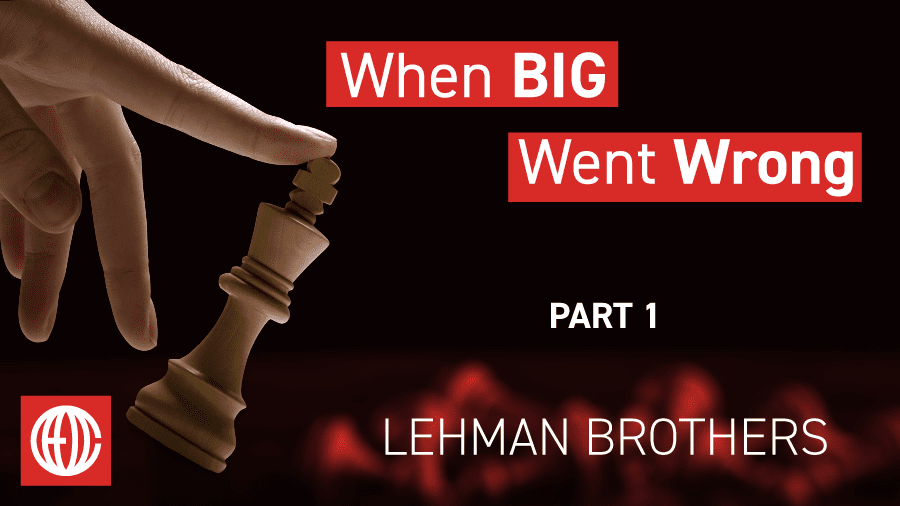
Part 1: Lehman Brothers — The $691 Billion Ego Trip
On September 15, 2008, Lehman Brothers filed for bankruptcy. It was the largest bankruptcy in American history—$691 billion in assets, gone. Within hours, global markets went into freefall. Within weeks, the world economy nearly collapsed.
But here’s what most people miss: Lehman didn’t die from the financial crisis. Lehman died from one man’s refusal to accept reality.
This is the story of how ego killed a 158-year-old institution—and the lesson every growth CEO needs to hear.
And for me, this one is personal.
The Company at Its Peak
In the early 2000s, when I was CEO of Platinum Capital, I used to sell large blocks of loans to Lehman Brothers. I walked their trading floor in New York. It was like something out of a movie.
The energy was intense—electric. Hundreds of sharp young professionals in dress shirts and ties, phones in both hands, screens flashing, deals closing. You could feel the ambition radiating off the walls. These were the best and brightest, and they knew it. Lehman wasn’t just a bank; it was a machine.
To understand how far they fell, you have to understand how high they climbed.
Lehman Brothers survived the Civil War, the Great Depression, two World Wars, and every market crash in between. By 2007, it was the fourth-largest investment bank in America. Revenue had grown from $3 billion to $19 billion in just seven years. The stock had increased tenfold.
Dick Fuld, the CEO, was nicknamed “The Gorilla.” He’d been with Lehman for 40 years and had run it since 1994. He was feared, respected, and by many accounts, absolutely convinced that he was the smartest person in every room.
In early 2007, Lehman was leveraged 30-to-1. For every dollar of actual capital, they had $30 in borrowed money at risk. They were deeply exposed to subprime mortgages and commercial real estate.
Fuld apparently didn’t see a problem. He saw opportunity.
The Decision Point
By spring 2008, the warning signs were everywhere. Bear Stearns had collapsed in March. The market was screaming that overleveraged investment banks were in mortal danger.
Lehman’s stock dropped 48% in a single week.
This was the moment. Right here. The fork in the road.
Fuld had options. Real options.
Option 1: Raise capital immediately. Korea Development Bank offered to invest $6 billion. Several sovereign wealth funds expressed interest. Warren Buffett’s team had exploratory conversations. The capital was available—at a price.
Option 2: Sell the company. Bank of America was interested. Barclays was circling. A sale at a discount would have been painful, but shareholders would have received something. Employees would have kept their jobs. The financial system would have stayed intact.
Option 3: Come clean on the losses. According to the court-appointed bankruptcy examiner’s report, Lehman was using an accounting maneuver called “Repo 105” to temporarily remove approximately $50 billion in assets from its balance sheet at the end of each quarter. Full transparency might have forced a painful reckoning—but it could have been survivable.
Fuld rejected all three.
According to multiple reports, he refused the Korean investment because he believed they were undervaluing Lehman. He reportedly rejected acquisition offers because he was convinced Lehman was worth more. And the accounting practices continued.
Instead, he appeared to choose Option 4: Bluff. Public statements reassured investors. Employees were encouraged to hold their stock. The message to the board was that they’d ride it out.
By all appearances, he chose his ego over his company.
Why He Got It Wrong
My firm has coached more than 2,000 CEOs, and I’ve seen this pattern before. It’s not stupidity—Fuld was brilliant. It’s not inexperience—he’d been in the game for four decades. It’s something more dangerous.
Identity fusion. Dick Fuld didn’t just run Lehman Brothers. By many accounts, he was Lehman Brothers. After 40 years, the line between the institution’s survival and his own self-worth had blurred. Selling the company may have felt like selling himself. Admitting the losses may have felt like admitting he was a failure.
When your identity becomes fused with your company, you lose the ability to make clear-eyed decisions about its future. Every strategic option gets filtered through “what does this mean about me?”
Isolation at the top. Fuld was known for his intensity. According to former employees, people were reluctant to bring him bad news. His inner circle reportedly told him what he wanted to hear. By 2008, he may have been operating in an information vacuum—convinced of realities that existed only in his own mind.
Anchoring to past success. Lehman had survived everything for 158 years. Fuld had turned it into a powerhouse. That track record became a trap. He apparently couldn’t imagine that this time was different. He seemed to keep waiting for the tide to turn, because the tide had always turned before.
Misreading the moment. Fuld appeared to believe the government would bail him out, just like they’d facilitated the rescue of Bear Stearns. He gambled that he was too big to fail.
He was wrong.
In 2019, I had the privilege of interviewing President George W. Bush at the Make BIG Happen Summit. I asked him directly: “Why did you save AIG and let Lehman fail?”
His answer was simple: “I had a team of very smart people advising me, and I listened to my advisors.”
The government had decided that moral hazard mattered—that someone had to face consequences. Lehman became that example.
What a Great CEO Would Have Done
Let me be direct: a great CEO would have taken the Korean money in June.
Yes, it was below what Fuld believed Lehman was worth. Yes, it would have diluted existing shareholders. Yes, it would have been reported as a sign of weakness.
But it would have meant survival.
Great CEOs understand something Fuld apparently never did: your job is to grow the company and protect it. Every major decision should be evaluated against those twin objectives. Taking the capital would have protected Lehman. It would have bought time to unwind bad positions, restore confidence, and negotiate from strength rather than desperation.
Fuld’s choice—bluffing, waiting, hoping—eliminated options every single day until there were none left. You can’t grow what no longer exists. You can’t protect what you’ve already lost.
A great CEO also builds a culture where bad news travels fast. By many accounts, Fuld built a culture where bad news was career suicide. By the time he understood how deep the hole was, it was too late to climb out.
The Lesson for Today’s Growth CEO
You’re scaling a company. Things are going well. You’ve got a track record of winning. That’s exactly when you’re most vulnerable to the Fuld trap.
Here’s what I want you to take from this:
1. Separate your identity from your company. You are not your business. Your worth as a human being is not determined by your valuation, your growth rate, or your exit multiple. The moment you can’t imagine life after your company, you’ve lost the objectivity required to lead it.
2. Create a culture where bad news moves faster than good news. If your team is afraid to tell you the truth, you’re flying blind. Ask yourself: when was the last time someone told me I was wrong? If you can’t remember, you have a Fuld problem.
3. Take the money when it’s offered. I see CEOs turn down capital, partnerships, and acquisitions because the terms aren’t “perfect.” There’s no perfect. A deal you don’t love beats a bankruptcy you didn’t see coming.
4. Know when the game has changed. The strategy that got you here won’t get you there. Past success is data, not destiny. When the market sends signals, listen. Fuld appeared to keep playing 2006 strategies in a 2008 world.
5. Your job is to grow and protect. Every decision should strengthen your ability to do both. Fuld’s choices systematically weakened Lehman’s position until protection was no longer possible. Great CEOs stress-test their positions. They ask “what if I’m wrong?” before the market forces them to find out.
The Final Count
Lehman’s collapse triggered a global catastrophe. The Dow fell 500 points the day of the bankruptcy. Within months, $10 trillion in global market value was erased. Unemployment doubled. Millions lost their homes.
Dick Fuld walked away with an estimated $500 million from his years at the top. He never faced criminal charges. He has maintained that he was a victim of circumstances beyond his control.
I walked that trading floor. I saw those young, ambitious professionals who believed they were building something permanent. They deserved better leadership.
Lehman Brothers didn’t die because of the financial crisis. Plenty of banks survived 2008. Lehman died because its CEO apparently couldn’t separate his ego from his strategy.
That’s a mistake you don’t have to make.
Next, in Part 2: Enron—The Company That Decided Truth Was Optional
Claim your Complimentary 1:1 Coaching Call
History is full of leaders who were right until they weren’t.
A free 1:1 coaching call gives you an outside perspective to challenge assumptions and sharpen decisions.
Share: