 Went Wrong:






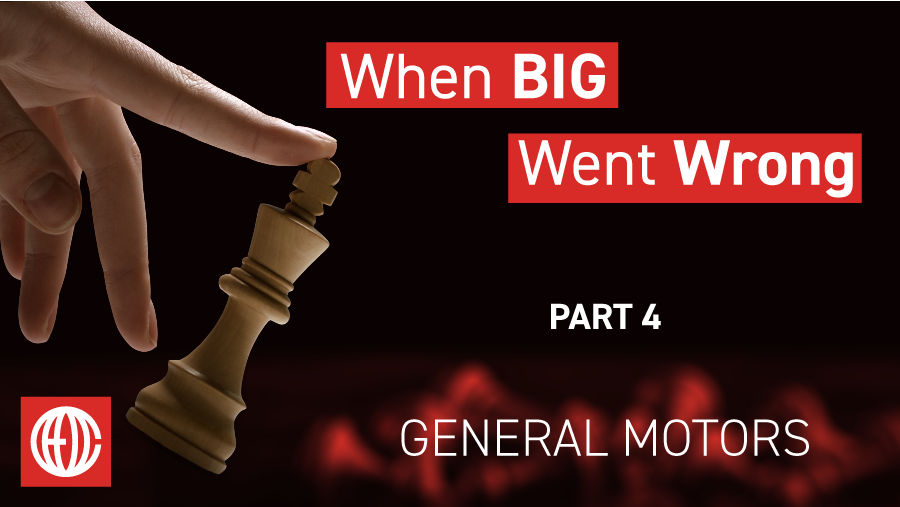
On June 1, 2009, General Motors filed for bankruptcy. It was the largest industrial bankruptcy in American history—$91 billion in assets, 235,000 employees worldwide, and a century of dominance brought to its knees.
The U.S. government injected $50 billion to keep the company alive. Entire communities in Michigan and Ohio held their breath.
But here’s the thing about GM’s collapse: it wasn’t sudden. It was decades in the making. A slow bleed that everyone could see but no one could stop.
GM didn’t die from a single bad decision. It died from a thousand small decisions to protect the past instead of building the future.
The Company at Its Peak
To understand GM’s fall, you have to understand how completely it once dominated.
In 1954, General Motors became the first corporation in history to earn $1 billion in a single year. By the 1960s, GM controlled over 50% of the American car market. At its peak, the company employed over 600,000 people in the United States alone.
“What’s good for General Motors is good for the country,” went the famous saying. And for a while, it was nearly true. GM was America’s industrial backbone—a symbol of manufacturing might, middle-class prosperity, and global leadership.
The company didn’t just make cars. It made the assumption that it would always be on top.
That assumption became the poison.
The Decisions That Killed Them
GM’s collapse wasn’t one decision. It was a pattern of decisions, repeated over decades, each one a small choice to protect short-term comfort over long-term survival.
Decision 1: Ignore the Japanese (1970s-1980s). When Toyota and Honda entered the American market with smaller, fuel-efficient cars, GM executives dismissed them. Many GM executives dismissed Japanese imports—often characterizing them as cheap cars for buyers who couldn’t afford “real” American vehicles. The 1973 oil crisis made fuel efficiency matter. GM’s response was slow, half-hearted, and arrogant. They assumed Americans would always want big cars, and that foreign competitors couldn’t match their scale.
By 1989, Toyota’s production system was so superior that it took them roughly 16 hours to build a car, compared to approximately 31 hours at GM.
Decision 2: Let legacy costs compound (1990s). GM’s labor contracts with the United Auto Workers included generous pension and healthcare benefits—promises made when the company was printing money. By the 2000s, GM was spending more on retiree healthcare than on steel. The company had 2.5 retirees for every active worker. Each car GM sold carried an estimated ~$1,500 in legacy costs that Toyota and Honda didn’t have.
GM’s leaders knew this was unsustainable. But renegotiating with the union was painful, and there was always a reason to defer the hard conversation to the next contract cycle. The can got kicked down the road until the road ended.
Decision 3: Chase profit margins, not market share (2000s). SUVs and trucks generated enormous profit margins—$10,000 or more per vehicle, compared to slim margins on sedans. So GM doubled down on big vehicles while ceding the car market to competitors. When gas prices spiked in 2008, GM was catastrophically exposed. Their bestselling products became unsellable almost overnight.
Decision 4: Refuse to restructure before crisis (2008). By early 2008, GM was bleeding cash and losing market share. CEO Rick Wagoner resisted calls for dramatic restructuring, bankruptcy, or a managed downsizing. The company burned through roughly $30 billion in cash reserves over about 18 months while waiting for the market to recover.
It didn’t recover. The financial crisis hit, credit markets froze, and car sales collapsed. By November 2008, GM was weeks from running out of cash.
Decision 5: Believe they were too big to fail. GM’s leaders appeared to believe—according to many contemporaneous observers—that the government would never let them collapse. They were right that they’d get a bailout. But they were wrong that it would come without consequences. The bankruptcy wiped out shareholders, decimated the workforce, and closed plants across America. Being “too big to fail” just meant the failure was managed, not avoided.
Why They Got It Wrong
My firm has coached more than 3,500 CEOs and senior leaders. GM’s pattern is one I’ve seen in companies of every size—the difference is just the number of zeros.
Incumbent arrogance. When you’ve been dominant for decades, you start to believe dominance is your birthright. GM’s executives couldn’t imagine a world where they weren’t #1. That failure of imagination made them blind to competitive threats that were obvious to everyone else.
Optimizing for today’s profits over tomorrow’s position. SUVs were enormously profitable in the short term. But chasing those margins meant abandoning the segments where the future competition would be won. GM traded market position for quarterly earnings—and lost both.
Legacy as a trap. GM’s pension and healthcare obligations were the result of past promises that made sense at the time. But those promises became anchors. Every year, the burden grew heavier. Every year, the cost of renegotiation seemed higher than the cost of deferral. Until deferral was no longer an option.
Diffusion of accountability. GM had been through so many CEOs, so many reorganizations, so many strategic initiatives that no single leader owned the failure. Each executive team inherited problems from the previous one and passed unsolved problems to the next. When everyone is responsible, no one is responsible.
Cultural inability to change. By the 2000s, GM’s bureaucracy was legendary. New ideas got killed by committees. Decisions that should take days took months. The company had become so large and so process-bound that it couldn’t adapt at the speed the market required.
What a Great CEO Would Have Done
The honest answer is that GM needed intervention decades before the 2009 collapse. By the time Rick Wagoner was running the company, the options were all bad. But even then, there were choices.
A great CEO would have recognized in 2006 or 2007 that the structure was unsustainable. Gas prices were rising. The truck-heavy product mix was increasingly risky. The legacy costs were eating the company alive. A great CEO would have forced the crisis early—restructured proactively, renegotiated labor contracts from a position of relative strength, and streamlined the product line before the market made those decisions for them.
Instead, Wagoner opted for incremental measures and delayed more radical action. He lobbied for government support. He cut costs incrementally. He hoped for a recovery that never came.
The hardest thing for a CEO to do is to create a crisis before the market does. It means telling your board, your employees, and your shareholders that major pain is coming—not because you failed, but because the alternative is worse. It means making yourself unpopular in the short term to protect the company in the long term.
That’s the job. And at GM, for decades, no one wanted to do it.
The Lesson for Today’s Growth CEO
GM is different from Enron or WorldCom. There was no fraud, no single villain, no dramatic moment where someone chose to lie. GM’s failure was slower and more ordinary—a gradual surrender to comfort, a long series of reasonable-seeming decisions that compounded into catastrophe.
That’s what makes it so relevant.
A few questions worth asking yourself:
1. Where am I protecting the past instead of building the future? Every company has its version of GM’s SUV strategy—a cash cow that’s funding the business but may not be where the market is going. What’s yours? And what happens if it goes away faster than you expect?
2. What promises have I made that might become anchors? Contracts, compensation structures, customer commitments—they all make sense when you sign them. But markets change. Are you building flexibility into your obligations, or locking yourself into positions that will be painful to exit?
3. Am I optimizing for this quarter or this decade? GM’s quarterly earnings looked fine for years while the foundation was rotting. What metrics would tell you if your long-term position is eroding, even if short-term results are solid?
4. Could I force the crisis before the market does? If you know something is unsustainable, waiting rarely makes it better. The restructuring you do from a position of strength is almost always less painful than the one forced on you by circumstances.
5. Has my company become too slow to adapt? As companies scale, process accumulates. Bureaucracy multiplies. Decisions that used to take a day take a month. At what point does that institutional weight become a competitive disadvantage? And what are you doing about it?
The Final Count
The bankruptcy cost 20,000 workers their jobs immediately, with tens of thousands more over the following years. Plants closed across Michigan, Ohio, and Indiana. Communities that had depended on GM for generations were devastated.
The U.S. government’s $50 billion investment was eventually recovered—mostly. Taxpayers are generally estimated to have lost ~$11 billion on the bailout. Whether it was worth it to save the remaining jobs and industrial capacity is still debated.
GM emerged from bankruptcy smaller, leaner, and more focused. The company is profitable today and has become a leader in electric vehicles. In some ways, the bankruptcy accomplished what decades of management couldn’t—it forced the restructuring that everyone knew was needed but no one was willing to initiate.
But think about what it took to get there: the largest industrial bankruptcy in history, tens of billions in government support, and the destruction of shareholder value that had accumulated over a century.
All because no one was willing to face the hard truths before the market forced them to.
GM didn’t die from a single decision. It died from the accumulation of small decisions to defer, to delay, to protect what was instead of building what could be.
That’s a slower death than fraud. But in some ways, it’s harder to prevent—because every individual decision seems reasonable. It’s only in the aggregate that the pattern becomes fatal.
Mark Moses is the Founding Partner & Executive Chairman of CEO Coaching International, which he founded in 2008, and the author of Make BIG Happen, Making BIG Happen and Built to Win BIG. His firm has coached 3,500+ CEOs and senior leaders in 94 countries and facilitated 150+ client exits totaling over $30.1 billion. He hosts the Make BIG Happen Podcast.